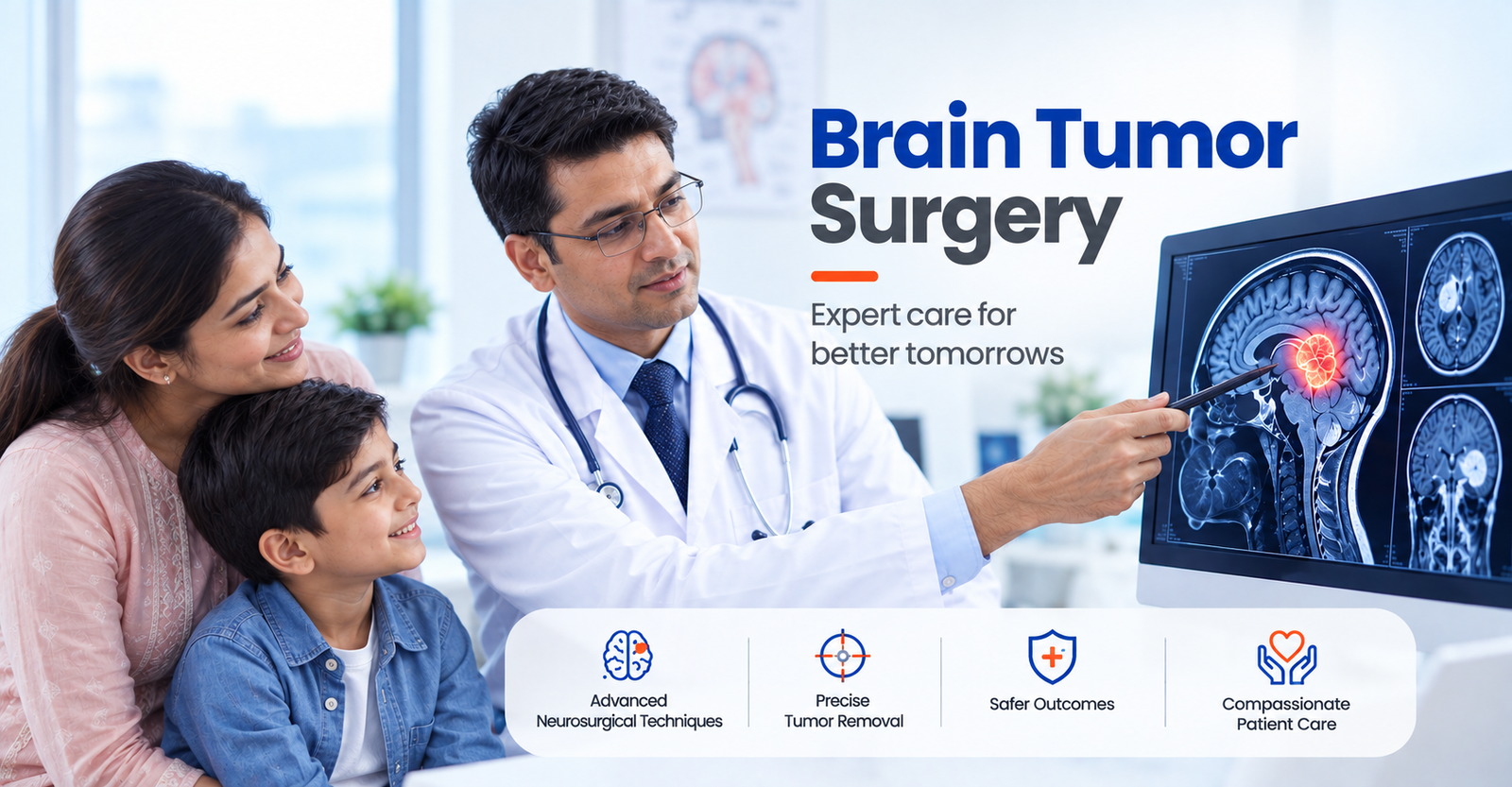
A brain tumour diagnosis can bring many questions for a patient and family— what the tumour means, whether surgery is needed, and what treatment may be appropriate. Brain tumour surgery is not one standard procedure for every patient. The approach depends on the tumour's location, size, type, symptoms and its relationship with important areas of the brain.
Dr. Gaurav Sharma, Senior Consultant – Neurosurgery, has over 14 years of clinical experience in neurosurgical care. His areas of expertise include brain tumour surgery, skull base surgery, endoscopic neurosurgical procedures, neuro trauma and complex spine care.
Every brain tumour is different. Good surgical planning begins with understanding where the tumour is, how it is affecting the patient and what treatment approach is appropriate for that particular situation.
The aim of consultation is to understand the diagnosis clearly and discuss the available treatment options in a practical, patient-focused manner. Where surgery is advised, the procedure is planned according to the individual clinical and imaging findings.

Brain tumours can present in different ways. Some patients may experience persistent headaches, seizures, changes in vision, weakness, difficulty with speech or changes in coordination. In other cases, a tumour may be detected during an evaluation for another concern. A neurological examination and appropriate imaging help guide the next step.
Dr. Gaurav Sharma's neurosurgical practice includes brain tumour surgery and related advanced procedures. Treatment planning takes into account the tumour's position and the patient's neurological condition, with the surgical approach selected according to the individual case rather than a one-size-fits-all method.
Brain tumour surgery refers to a range of neurosurgical procedures used to evaluate, remove or manage a tumour when surgery is considered appropriate. The exact technique depends on the nature and location of the tumour and its proximity to important brain structures. In some situations, surgery may also provide tissue for a detailed diagnosis.
Surgery may be considered when a tumour is causing symptoms, producing pressure on surrounding brain tissue, or when obtaining or removing tumour tissue is part of the treatment plan. The decision is based on clinical assessment and imaging, and not simply on the presence of a tumour on a scan.
Careful planning is particularly important in brain surgery because different parts of the brain have different functions. Imaging findings, neurological symptoms and the tumour's relationship with nearby structures are considered while planning the operative approach.
Tumours located around the skull base can be technically complex because they may lie close to nerves, blood vessels and other important structures. Dr. Gaurav Sharma has expertise in skull base surgery and advanced neurosurgical procedures for selected complex conditions.
During consultation, the patient's symptoms, medical history, neurological examination and available scans are reviewed. The discussion can help explain the diagnosis, whether surgery is being considered, the proposed approach and what other treatment options may be relevant to the individual case.
Dr. Gaurav Sharma is a Senior Consultant – Neurosurgery with over 14 years of clinical experience. His areas of expertise include brain tumour surgery, skull base surgery, endoscopic neurosurgical procedures, aneurysm surgery, spine tumour surgery and brain and spine trauma management. Patients can discuss their reports and treatment options during a detailed neurosurgical consultation.